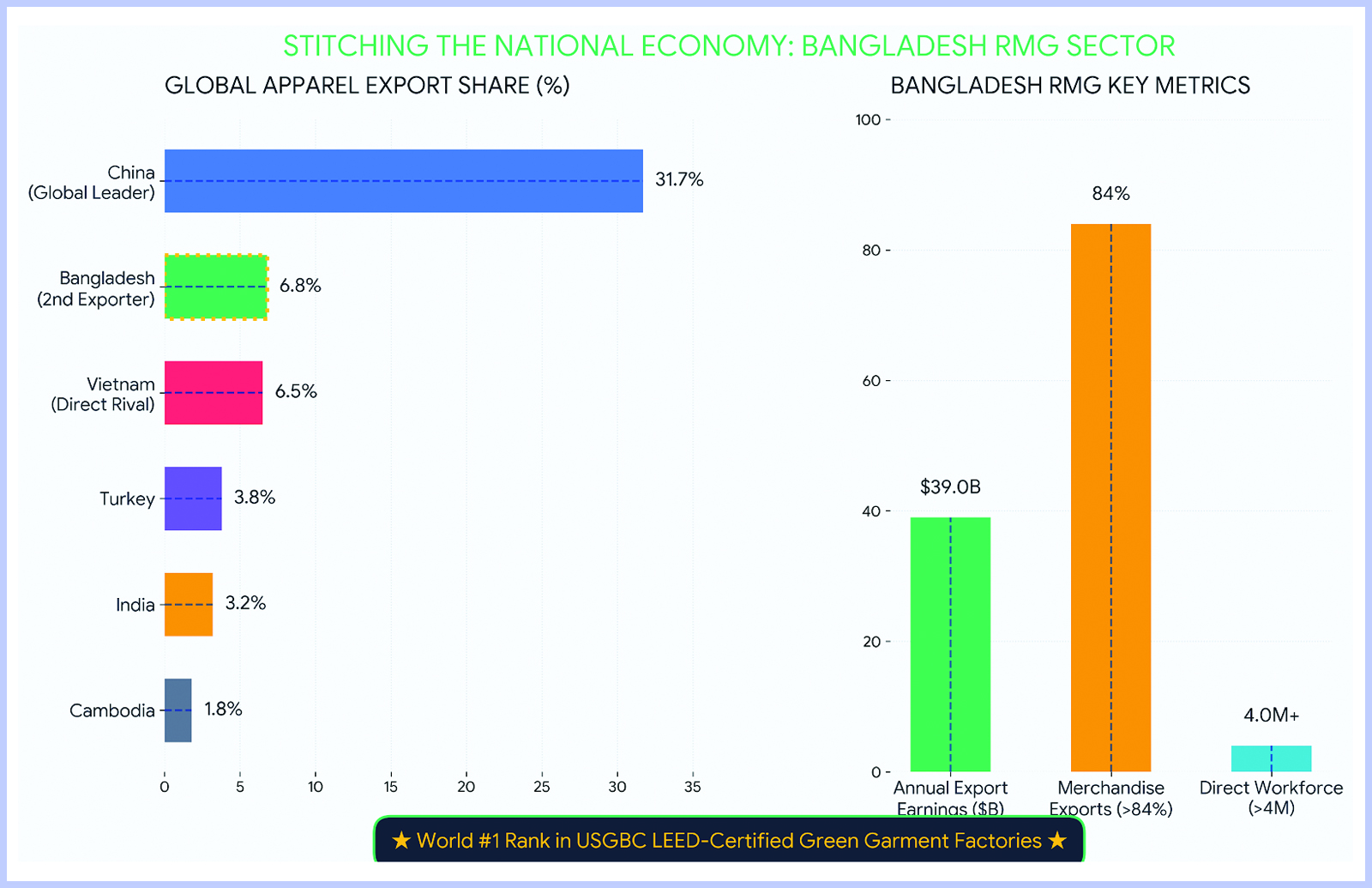
Amid the steady, rhythmic hum of thousands of sewing machines across Gazipur, Savar, and Narayanganj, an entire nation’s economic momentum takes shape. The Ready-Made Garment (RMG) sector is not merely an export driver for Bangladesh; it is the fundamental engine of its national economy.Generating roughly $38.7 billion to $39 billion in annual export earnings, apparel accounts for over 84% of Bangladesh’s total merchandise exports and directly employs upwards of four million workers—the vast majority of whom are women from rural communities.Beyond simple low-cost manufacturing, the industry has quietly executed a major transformation: Bangladesh now boasts the world’s highest concentration of USGBC LEED-certified green garment factories, turning eco-conscious production and social compliance into a cornerstone of its modern industrial identity.
On the global stage, Bangladesh maintains its standing as the world’s second-largest apparel exporter, commanding roughly 6.8% of total global market share.While it trails global leader China, the country faces an increasingly tight, neck-and-neck rivalry with Vietnam, alongside expanding pressure from regional competitors in India, Cambodia, and Turkey.
Traditionally built on high-volume cotton knitwear—such as t-shirts, polo shirts, and denim—Bangladeshi manufacturers are now actively attempting to pivot toward higher-value garments, activewear, and synthetic man-made fiber (MMF) blends to protect their margins and market footprint.
Yet, this industrial juggernaut stands at a critical crossroads, confronted by compounding headwinds. Domestically, factories struggle with volatile energy availability, acute gas shortages, high borrowing rates, and rising operational expenses. Globally, the impending graduation from Least Developed Country (LDC) status presents a structural test, as the eventual loss of duty-free tariff preferences in key European and Western markets threatens landed price competitiveness. Compounded by shifting buyer demands for faster lead times, smaller order quantities, and strict carbon footprint reporting, the sector can no longer rely solely on scale and cheap labor.
To secure its legacy and sustain national growth, Bangladesh’s garment industry must complete its transition from a volume-driven supplier to an agile, value-added manufacturing partner. Achieving this requires aggressive market diversification across Asia and Latin America, stronger backward integration into raw materials, and continuous policy support to ensure uninterrupted power and port efficiency.
As global apparel sourcing enters an era defined by sustainability and speed, the resilience of Bangladesh’s shop floors will determine whether the nation continues to clothe the world for decades to come.