
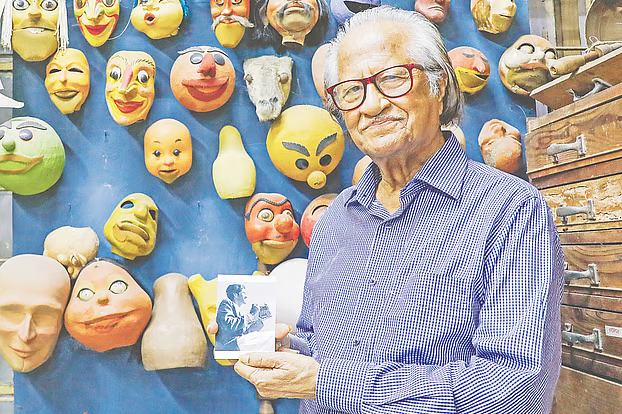
I was in the second year in 1960-61. I don’t remember the exact date. One morning, the principal Zainul Abedin and senior teacher Anwarul Haque came to the class. With them was Subeshi, who looked quite young. Abedin Sir introduced him. He said, ‘This is Mustafa Monowar. He has passed from the Government College of Art, Kolkata. From today, he will take your class.’
In the second year, there was a shortage of class teachers because artist Rashid Chowdhury went to Spain for higher studies. Since there was no fixed teacher, sometimes the principal himself would take the class, and sometimes it would be artist Kamrul Hasan or artist Safiuddin Ahmed. We actually benefited from that. We got the experience of seeing different teachers’ varying teaching styles and methods of conducting classes. We were happy with this arrangement.
I remember, a few years ago I once went together to my family home in Rajshahi and Chapainawabganj. While on the plane, he said at one point, ‘You know, something coincidental happened today.’ I noticed a hint of pride in his words. He paused for a bit and said, ‘My son is going on this flight today.’
So, we suddenly felt worried when a new teacher was assigned. We wondered what kind of person he would be and how he would take the class. But that worry soon went away with what the new teacher said. He mentioned that there are many rules and grammar in drawing. If you want, you can follow all of them, but sometimes you can also use your own creativity. You can overcome stiffness and draw freely in your own way.
I understood a bit of what he said, but I didn’t really grasp it until I saw him paint that way. Especially the part about watercolor—how to paint it quickly—he had shown it himself. At first, I would get all confused trying to paint like that. Later, I got the hang of it quite a bit.
He also had us practice how to take speed into account in drawing sketches. Later, after moving up to the third year, I took a few painting classes. That had a different vibe too. He taught us the smart trick of changing the usual academic rule of starting with dark, gradually moving to mid-tones, and then reaching the light.
First, by applying color in mid-tones and then adjusting to darker or lighter shades as needed, our style of painting also changed. These were the innovative aspects of painting. But there were a few other things that made him a popular teacher, which made students interested in him.
After joining the art college as a teacher, it didn’t take long for the overall atmosphere of the institution to start changing. The strictness that was everywhere in the college began to ease little by little, especially on the cultural side. In fact, he was very talented in music. If he had focused on music instead of painting, he could have become a major or renowned artist. So, he often organized musical events at the college.Notably, in Kolkata, his record was also made at His Master’s Voice at 78 RPM, and he had played it for us.
He used to sing folk songs at college events at the request of Sir Abedin. Among them were ‘Na jani ki korlo re amay ki jani ki dia, sonaybandailnaopitergola, aga naowedubodubo, pichanaoweboiso’, ‘Oki gadiyal bhai’, etc. He also used to perform soulful songs by Kael Saigal, Pankaj Mallick, and C.H. Atmar.
Saigal’s Rabindra Sangeet feels a bit touching, and ‘Pritam Anmilo’ was his favorite. He used to sing it quite often. Whenever there was a program, we would ask him to sing these, and he would agree.
Whatever he did, he would involve the students and sit with them. It changed the atmosphere of the college. The distance between students and teachers had reduced significantly. They started exchanging ideas, especially centered around the arts. Because of various events, their connection with the outside cultural world also increased.
He was a devoted fan of Rabindranath Tagore. He regularly read Tagore’s poems and literary works, listened to Rabindra Sangeet, sang them himself, and practiced regularly. At the same time, he tried to inspire others. During the celebration of Rabindranath’s birth centenary, while there were strict governmental efforts to suppress Rabindra studies in East Pakistan, he staged plays like Taser Desh and Shyama. Young people performed in them.
Many of them later became prominent actors in the country. Around the same time, he also ran a post office at the art college with the students. Everyone in the country’s cultural circles was impressed by these qualities. He gained a great reputation. The staging of the play was also praised in newspapers and magazines.
Maybe that’s why he left college in 1964 to start working at the first pilot TV in Dhaka—‘PTV’. I still feel he had found the medium that suited his own creative expression. His dream also got to take shape at this institution. I had heard that because of his cultural activities—his thoughts on these matters and his reputation—PTV’s advisory artists like Zainul Abedin, Kalim Sharafi, and Patua Kamrul Hasan, among others, nominated and encouraged him for the job.
So, being involved in a creative medium like television had established him in a different world. He had brought a new dimension to entertainment on TV and for the country.
Because he was so focused on TV activities and puppets, and busy with all that, he had drifted away from his main field of painting. He even had some regrets about it. He often thought about it. He would say, ‘It’s time to get down to painting properly. The time has come to hold an exhibition.’
He had left art college, but he still got involved in various college activities. The reason was that he was primarily a painter. He used to say that he considered the sensibilities he gained from his art education as fundamental knowledge. Everything creative he did in life was the result of what he learned at the Kolkata Art College and the experience he gained interacting with other artists. Renowned Indian artists Ganesh Pyne and Sunil Das were his classmates. He used to talk about those experiences.
So, even though he was involved in many other things, he had a soft spot for people in the world of arts and culture. That’s why he was connected to many things for the sake of this field. Not just that, he also liked socialising with everyone in the arts. I often got the chance to join those gatherings too. In those moments, I would discover him as the mediator. He would have wonderful things to say about any topic. Arts, literature, music, drama, cinema—in short, he enjoyed talking about the overall cultural matters of the country. He had a keen eye for all the details in these areas.
He didn’t usually talk much about politics. But his work showed a conscious political presence. In the 1960s, every year on February 21, the events that were organized always had politics at their core. Even though he was a high-ranking government official, he was involved in all of it and played a leading role in the protest-themed art shows centered around the Shaheed Minar. He would paint those big pictures on huge canvases in open spaces, mingling with everyone.
My drawings used to be cartoonish. Maybe that's why he praised them. But I knew that from the mid-fifties to the early sixties, he used to draw cartoons called Montu. The humorous cartoons were published in the popular biweekly magazine ‘Sanchari Sandhani’.
We saw another example of his political wisdom on March 23, 1971. At that time, the country’s situation was heading towards a terrible crisis. The Yahya government was taking a hardline stance. During that tough period, under his leadership, PTV stopped using Pakistani national songs and the flag. As a result, he had to go into hiding, and when the Pakistani army started massacres and arrests on March 25, he left the country.
While staying in Kolkata, he saw the gloomy state of sad children in refugee camps and vowed to make puppets to entertain them. That’s exactly what he did. In the stories of those puppets, he emphasised patriotism. He also mixed in humor to make the children smile. At the same time, he included messages about loving one’s own country. This puppet show became very popular.
Actually, he spent most of his life working with puppets. He even founded an organisation. His puppets gained international recognition and fame. The puppets were symbolic. While creating meaningful works about the country, people, animals, birds, nature, and time, he used his own childlike mind. He practiced that childlike psychological aspect in his work. He also arranged stories in the same way. In this regard, he has a famous and popular character named Gitthu.
He had a weakness for puppets since childhood. He was drawn to the puppet shows practiced in villages across the country. He used to watch them with great attention. He thought about the little details and the aspects of creating humor in folk rules. While studying at the Kolkata Art College, he got involved in puppet making. Since then, it had occupied a place in his mind. While working in television, he started working in this medium. He modernised puppets to make them contemporary.
I remember, there was a time when the renowned musician Ferdousi Rahman used to teach songs to children on TV. To make the song-teaching sessions fun and engaging, they used a puppet of a crow with a hoarse voice. That was her creation. She was also the pioneer of new children’s programs on TV. The truth is, she really cared a lot about children and their joys. That’s why she got involved with the Children’s Academy. Because of her versatile talents and achievements, she held the position of Director General of the Art Academy.
He loved to travel. He would visit remote parts of the country because of work. Sometimes he would leave with us too. We really enjoyed that. In such situations, his presence became very engaging. He would talk about his life, likes and dislikes, various social issues, and experiences in a fun way. When sharing stories about his time studying in Kolkata, he would get excited talking about his childhood in Dhaka and about Narayanganj. He would also amusingly tell how he ended up in jail as a school student during the 1952 language movement in Narayanganj.
I remember, a few years ago, I had gone together to my family home in Rajshahi and Chapainawabganj. While on the plane, he said at one point, ‘You know, something coincidental happened today.’ In his words, I subtly noticed a hint of pride. He paused for a bit and said, ‘My son is going on this flight today.’
Hearing that, I asked, ‘Hey, I didn’t see him. I haven’t even seen him come in front of you! Where is he?’ He just smiled and said, ‘In the cockpit. He’s in charge of flying the plane today. This is his first flight as the chief pilot.’ Hearing this made me really happy. So, this highly creative, always-busy great person has left us forever, leaving everyone who knew him in mourning. But he will live on through the creative work he left behind and in everyone’s memory. I pray for his soul’s peace. Also, my condolences to the whole family.
Rafiqun Nabi: Emeritus Professor and Renowned Painter