
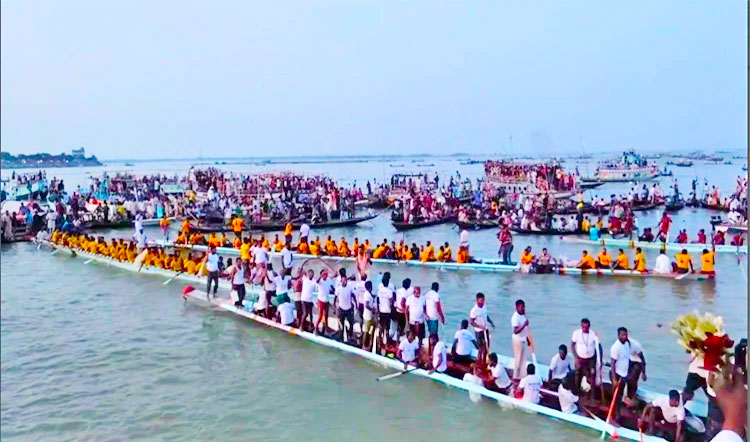
Under clear autumn skies, as Bangladesh's rivers, canals, and expansive wetlands swell with the trailing waters of the monsoon, the countryside erupts in the celebratory spirit of its age-old water festival: Nouka Baich (the traditional boat race). This spectacle brings together hundreds of synchronized oarsmen whose rhythmic strokes echo against the roaring cheers of hundreds of thousands lining the riverbanks. Even in an age dominated by digital entertainment, this grand fusion of speed, heritage, and communal spirit retains its timeless allure.
Recently, a long drought of festivities came to an end as rivers across the nation echoed once again with the chants of Sarigaan (traditional boatmen’s songs) and the splash of oars. Long-dormant races made dramatic returns: from the Ghorautra River in Kishoreganj on September 18 after a 17-year hiatus, to the historic Buriganga in Dhaka on August 21—which also saw a symbolic water festival hosted at Nawab Bari’s Gol Talab for the first time in 32 years. Similar revivals took place on the Titas River in Brahmanbaria (September 12), the Kumar River in Faridpur (September 18), and the Gorai River in Kushtia, breathing fresh vitality into a thousand-year-old tradition that effortlessly bridges rural roots and urban communities.
History, Heritage, and Soul
Boat racing is an essential thread in the cultural fabric of riverine Bangladesh. Intertwined with the daily life and survival of delta communities, these grand aquatic celebrations typically peak during the Bengali months of Shravan and Bhadra, when rising waters fill the haors and rivers, evoking the essence of the alluvial soil.
Legends surround the origins of Nouka Baich. Some trace it back to the ancient bathing rites of Lord Jagannath; others credit the naval maneuvers of medieval Nawabs and zamindars. Regardless of its historical beginnings, for the people of Bengal, the race is a celebration of unity, equality, and collective spirit.

PHOTO: Courtesy
Craftsmanship and the Fleet
Everyday working craft are set aside for the races. Instead, specialized vessels measuring anywhere from 100 to 200 feet are custom-crafted with intricate wood carvings and vibrant paintwork. Their raised front hulls (Golui) often feature sculpted figureheads of peacocks, lions, or mythical beasts.
-
Chhip & Kosha: Ultra-narrow, streamlined boats built for rapid acceleration and sharp movement through narrow waters.
-
Moyurpankhi: Regal vessels styled with prominent peacock-shaped prows.
-
Khelna, Goyna, & Ghashi: Larger, heavier-duty racing boats designed to weather expansive open waters.
Rhythm, Speed, and Sarigaan
A single racing boat typically seats 50 to 100 rowers (Mallas), dressed in matching uniforms with traditional gamchhas tied around their foreheads. Guiding this team is the Noya Ganger Kandari (helmsman), who stands in the center or bow playing cymbals and leading the cadence with high-energy Sarigaan folk songs, such as:
"Heio Re Heio, Joan Bhaisala Heio..."
Paddled in rhythm with these chants, a hundred oars hit the water in unison, hurling cascades of spray as the boat surges forward at breakneck speed.
Financial Mirror/AH