
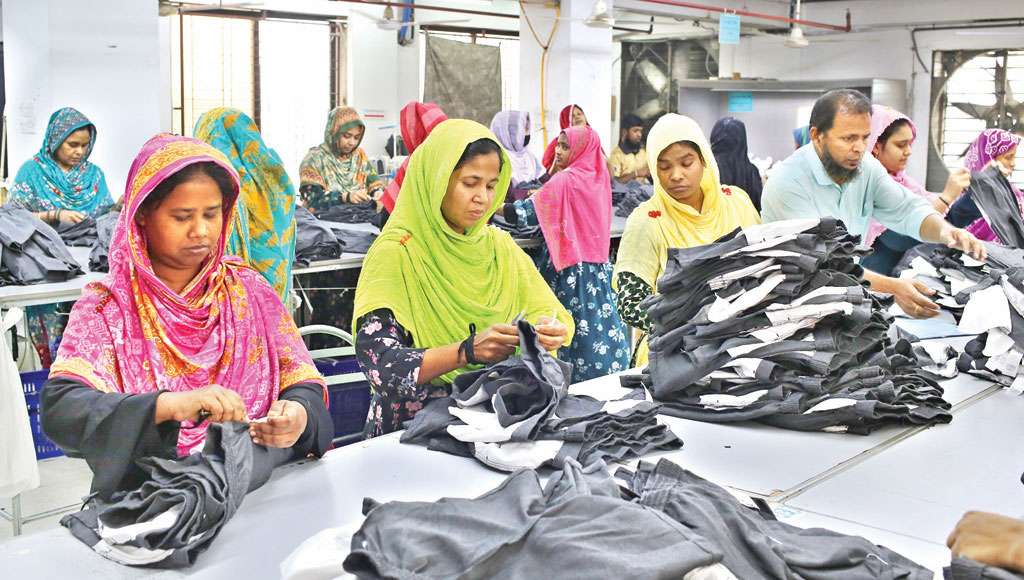
The country’s readymade garment shipments to major export destinations showed mostly positive performance in the July-September period, the first quarter of the financial year 2026-27, with overall earnings rising.
RMG exports grew by 6.10 per cent to $10.58 billion, up from $9.97 billion in the same period of FY26, according to data from the Export Promotion Bureau, compiled by Bangladesh Apparel Voice.
The EPB has said the performance reflects resilience of the country’s export sector and sustained confidence of international buyers.
The state agency also said it remains committed to supporting export diversification, market expansion, product upgrading and trade facilitation to sustain export growth and achieve the country’s long-term export objectives.
Knitwear exports rose by 6.88 per cent to $5.96 billion, outpacing woven garment exports, which grew by 5.11 per cent to $4.61 billion.
The European Union, Bangladesh’s largest apparel destination, recorded exports of $4.90 billion in July-September of FY27, up 3.33 per cent from $4.75 billion in the same period a year earlier.
The EU’s share of Bangladesh’s total RMG exports stood at 46.36 per cent during the period.
Among major EU markets, Germany, France, Italy, Denmark and Austria recorded declines, while Spain, the Netherlands, Belgium, Sweden and Poland posted growth.
Germany, the largest EU market, dipped 0.15 per cent to $1.12 billion in the first three months of FY27, from $1.12 billion in the corresponding period of FY26.
France fell 4.91 per cent to $449 million, Italy declined 5.82 per cent to $316 million, Denmark dropped 15.40 per cent to $201 million and Austria fell 14.03 per cent to $19.49 million.
Among the markets that posted growth, Spain rose 13.73 per cent to $1.15 billion, the Netherlands grew 9.02 per cent to $597 million, Sweden climbed 14.43 per cent to $177 million, Poland increased 5.77 per cent to $402 million and Belgium edged up 1.39 per cent to $130 million.
Exports to the United States, the single largest destination for Bangladeshi RMG, rose 10.40 per cent to $2.22 billion from $2.01 billion, with the market accounting for 20.99 per cent of total RMG exports despite tariff and global geopolitical tensions.
Shipments to Canada grew 3.85 per cent to $350 million in July-September of FY27, from $337 million, with the market accounting for 3.31 per cent of total exports.
RMG exports to the United Kingdom rose 5.94 per cent to $1.29 billion in the first three months of FY27, from $1.22 billion in the same period a year earlier, with the UK’s share of total exports at 12.21 per cent.
In the apparel trade, the US, Canada, the UK and the EU are considered traditional markets, while other destinations are classified as non-traditional markets.
Major non-traditional markets include Japan, Australia, Russia, India, China, South Korea, the United Arab Emirates, Malaysia, Brazil and Mexico.
Exports to non-traditional destinations grew 9.40 per cent to $1.81 billion in July-September of FY27, up from $1.66 billion in the same period of FY26, and accounted for 17.13 per cent of total RMG exports.
Among major non-traditional markets, exports to India and Russia witnessed declines in July-September of FY27, while exports to Japan, Australia, China, South Korea, Brazil, Turkey, Saudi Arabia, the United Arab Emirates, Malaysia and Mexico recorded positive growth, the EPB data showed.
Bangladesh Knitwear Manufacturers and Exporters Association executive president Fazlee Shamim Ehsan said that August was marked by a fuel crisis throughout the month.
Even so, the export growth in September compared with the same month last year is undoubtedly positive, he said.
Despite most factories facing the crisis, it is possible that some managed to achieve exceptionally high exports through their own efficiency, which might have contributed to the growth, he added.
Mohiuddin Rubel, former director of the Bangladesh Garment Manufacturers and Exporters Association, said that positive export growth amid the current global and domestic challenges was encouraging and reflected the sector’s resilience.
Despite geopolitical tensions, the global energy crisis and domestic gas and electricity shortages, the growth was a positive sign, he said.
He said that non-traditional markets had returned to positive growth after experiencing a prolonged negative trend, while exports to the US were also showing signs of recovery.
He stressed the need to make the growth profitable and sustainable by focusing on high-value products, innovation, market diversification and diversification within product categories.
In FY26 as a whole, the RMG sector earned $38.70 billion, a 1.64 per cent decline from $39.35 billion in FY25.
Financial Mirror/AH