
Despite a series of concessions from the central bank to facilitate loan rescheduling and reduce the reported level of defaults, defaulted loans in Bangladesh’s banking sector continue to rise. The government has also announced a special incentive fund to revive closed factories, but these initiatives have yet to reverse the trend. During the first six months of this year, defaulted loans increased by Tk 49,338 crore, reaching roughly one-third of total outstanding loans. The current default-loan ratio is among the highest in the world.
Banking sector stakeholders said the sharp increase reflects a more accurate picture of the sector’s financial condition. Following the fall of the Awami League government, several influential businessmen accused of financial irregularities and fraud have gone into hiding, while some have been arrested. According to concerned officials, various practices previously used to conceal defaulted loans have been curtailed, allowing banks to present a more realistic picture of their financial liabilities. The interim government had also emphasized the importance of bringing the actual situation to light.
The high level of defaulted loans has adversely affected bank profitability. In 2025, only 16 of the 36 banks listed on the capital market were able to pay dividends. Bangladesh Bank has since tightened dividend-payment rules for 2026. Under the new rules, banks with more than 10 percent of their loans classified as defaulted and paid-up capital below Tk 2,000 crore will not be allowed to pay cash dividends.
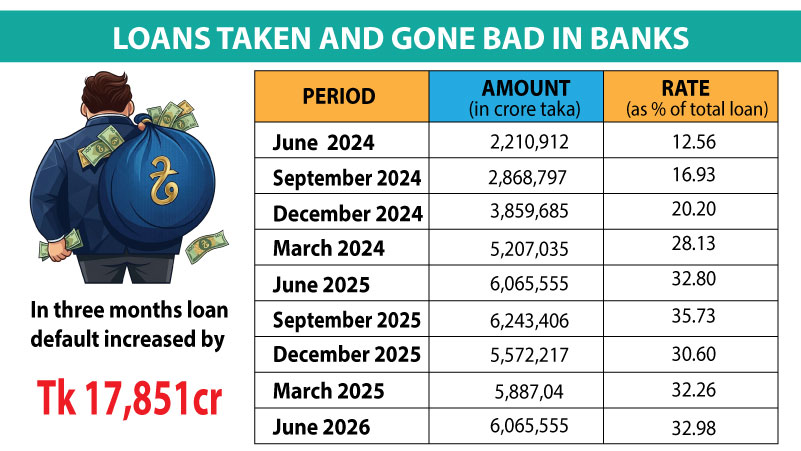
According to Bangladesh Bank data, total outstanding loans in the banking sector stood at Tk 18,50,381 crore at the end of June. Of this amount, Tk 6,06,555 crore had become defaulted, accounting for 32.78 percent of total loans. At the end of March, defaulted loans stood at Tk 5,88,704 crore, or 32.26 percent of outstanding loans. This means defaulted loans increased by Tk 17,851 crore in just three months. At the end of December, the amount stood at Tk 5,57,217 crore, representing 30.60 percent of total loans. Overall, defaulted loans increased by Tk 49,338 crore during the first six months of the year.
The volume of defaulted loans has risen sharply since the interim government began efforts to reveal the actual condition of the banking sector. For the first time in Bangladesh, defaulted loans crossed Tk 6 lakh crore in June 2025, reaching Tk 6,08,345 crore. In the following quarter, the figure rose further to Tk 6,44,515 crore, equivalent to 35.73 percent of total loans. The sharp increase triggered widespread concern and prompted the authorities to introduce special arrangements for loan rescheduling. At the same time, Bangladesh Bank restricted dividend payments for banks whose defaulted loans remained above 10 percent. These measures encouraged banks to intensify their loan recovery efforts, resulting in a Tk 87,298 crore decline in defaulted loans during the final quarter of last year.
The rise in defaulted loans becomes even more significant when viewed over a longer period. When the Awami League government came to power in 2009, defaulted loans stood at just Tk 22,481 crore. By the end of 2023, the figure had increased to Tk 1,45,633 crore, representing around 9 percent of total loans. After the fall of the Awami League government, Bangladesh Bank published a report in September 2024 based on June data, showing that defaulted loans had surged by around Tk 66,000 crore within three months to Tk 2,11,391 crore. Since then, the amount has continued to rise rapidly.
Bangladesh Bank officials said that during the Awami League government, several methods were used to keep the reported level of defaulted loans low. Loans were sometimes rescheduled or restructured under special arrangements, while some loans were shown as regular even though repayments had not been properly recovered. Borrowers were also given additional time to repay their loans. Officials identified a major change introduced in 2019 as another factor that helped suppress the reported volume of defaults. Normally, loan maturity is determined after the repayment period expires, but from 2019, maturity for term loans was calculated six months after the repayment deadline. The interim government later removed this provision, although some stakeholders have now called for its reinstatement. No decision has yet been made on the matter.
After taking office, the BNP-led government has introduced a series of concessions rather than relying solely on stricter measures to reduce defaulted loans. An incentive package worth Tk 60,000 crore has been announced to help restart closed factories, despite continuing gas and power shortages. The policy interest rate has also been reduced amid high inflation, while the credit limit for individual customers has been increased. In a recent directive issued on Monday, Bangladesh Bank allowed loans exceeding Tk 1,000 crore to be rescheduled for up to 15 years, including a two-year grace period. Borrowers who had previously received a one-year grace period can now receive an additional year, bringing the total to two years. Applications for these facilities can be submitted until next September, marking the fourth extension of the deadline.
However, these concessions have not generated a strong response from many large loan defaulters. A significant number of major borrowers accused of loan default and other financial crimes, including money laundering, are reportedly absconding. At the same time, continuing gas and power shortages have made banks reluctant to provide low-interest loans under incentive programmes. As a result, despite repeated policy support and rescheduling facilities, the country’s banking sector continues to struggle with an unprecedented level of defaulted loans.