
From national seminars to newspaper opinion pages, Bangladesh is often showcased as a country that is on the cusp of a green revolution. One could easily believe that our renewable energy potential is limitless and that it is just a lack of political willingness that is slowing us down. The Government of Bangladesh is also ambitious. And so are the pundits. Hence, the renewable revolution often seems extremely doable. But once we go past the buzzwords and the over optimism, the question comes up, how much of the hype is real?
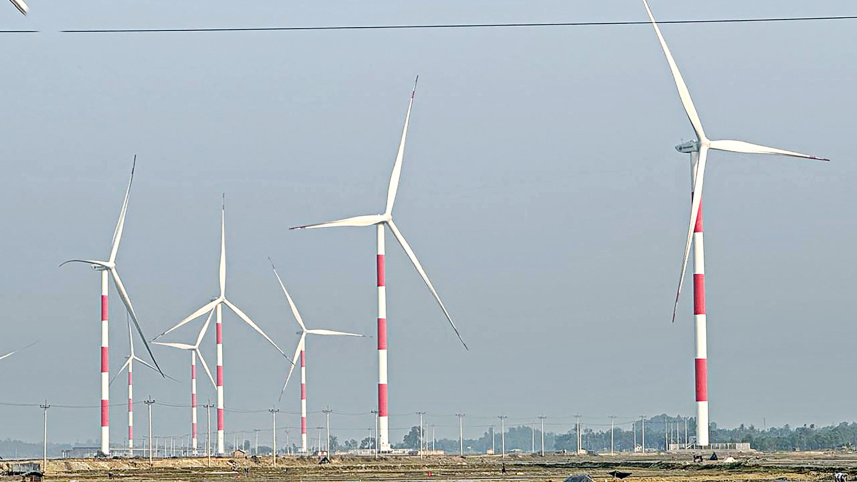
Optimists argue that Bangladesh's energy transition is an economic and strategic necessity. That it is, driven by the falling global costs of solar and wind. This narrative suggests that shifting to renewables will shield the economy from volatile fossil fuel prices, for example, the uncertainty we are seeing because of ongoing US-Iran tensions right now. While non-arable lands and smart grid upgrades can bypass land scarcity and technical hurdles, that is a very real issue for Bangladesh. Similarly, modern wind technology is being championed as a gamechanger for Bangladesh's power sector, with assurances that technical breakthroughs can finally overcome our geographic limitations. Some experts have suggested that Low Wind Speed (LWS) turbines, equipped with much taller towers and larger, more aerodynamic blades, allow us to capture consistent, high-velocity winds at altitudes previously out of reach. They believe that areas once dismissed as dead zones are now commercially viable energy hubs. By positioning these turbines in coastal belts and offshore sites, Bangladesh can achieve true energy sovereignty, as per such positive viewpoints. And the optimists are not entirely wrong. Bangladesh does have scope of renewable energy generation. According to IRENA's Renewable Power Generation Costs in 2023 report, solar PV module prices fell by approximately 93% between December 2009 and December 2023. This helped bring the global weighted average total installed cost for utility-scale solar down to USD 758/kW in 2023.According to IRENA’s Renewable Power Generation Costs in 2024 report, this cost fell further to USD 691/kW in 2024, with the Levelized Cost of Electricity (LCOE) reaching a competitive USD 0.043/kWh that year. Wind technology has seen similar gains in competitiveness. The global weighted average LCOE for offshore wind was USD 0.075/kWh in 2023 and reached USD 0.079/kWh in 2024.
But such arguments often ignore a very important facet of energy production, that is the storage capacity. Even if we achieve these global technological and pricing benchmarks, Bangladesh would struggle with the storage of such energy. Comparing intermittent solar to dispatchable gas is fundamentally flawed. A gas plant provides power during a 2 AM heatwave, however, a solar panel does not. To make solar a true replacement for thermal power, you must start the discussion on batteries. Once one factors in storage, solar PV including batteries will not achieve a cheaper LCOE than thermal power in Bangladesh until 2030 at the earliest and even then, only for new-build plants, not the scale of capacity the grid needs to add before then. For a nation with power demand growing at 7% annually, "waiting for 2030" is a luxury our economy simply cannot afford.Then, there is the arithmetic of our national targets.The Renewable Energy Policy 2025 targets 30% by 2040 and 20% by 2030. Such targets are aimed to be proof of momentum, but this is a linguistic tactic. To achieve these targets in the next 4 years, would require a deployment speed and land acquisition scale that is physically and legally unprecedented in our hyper-dense delta of Bengal. Perhaps the grimmest reality check comes not from researchers, but from the market. If the transition were as inevitable and easy as many claim, investors would be rushing in. They aren't. Despite offering 46 bid documents for 55 grid-based solar power plants totaling 5,238 MW, the Bangladesh Power Development Board (BPDB) is facing a significant lack of investor interest. Following two rounds of tendering, the second phase saw a disappointing turnout, with only 21 bids submitted for a mere 10 of the proposed plants. With Moody's downgrading Bangladesh to a B2 rating in November 2024, the cost of capital has skyrocketed.When combined with a budget that offers no new incentives and the removal of payment guarantees, the "Green Revolution" becomes effectively unbankable. Globally, the price of stationary energy storage has reached a stunning low of $70/kWh in 2025, a milestone that proponents of the green transition cite as proof that the end of fossil fuels is near. However, for a power sector managed from Dhaka, these global benchmarks are little more than academic abstractions. The reality is that these savings evaporate the moment they cross our borders, as a B2 credit rating that forces Bangladesh to borrow at punishingly high interest rates for its many projects, the "cheap" battery of the global market becomes a luxury item on our grid.
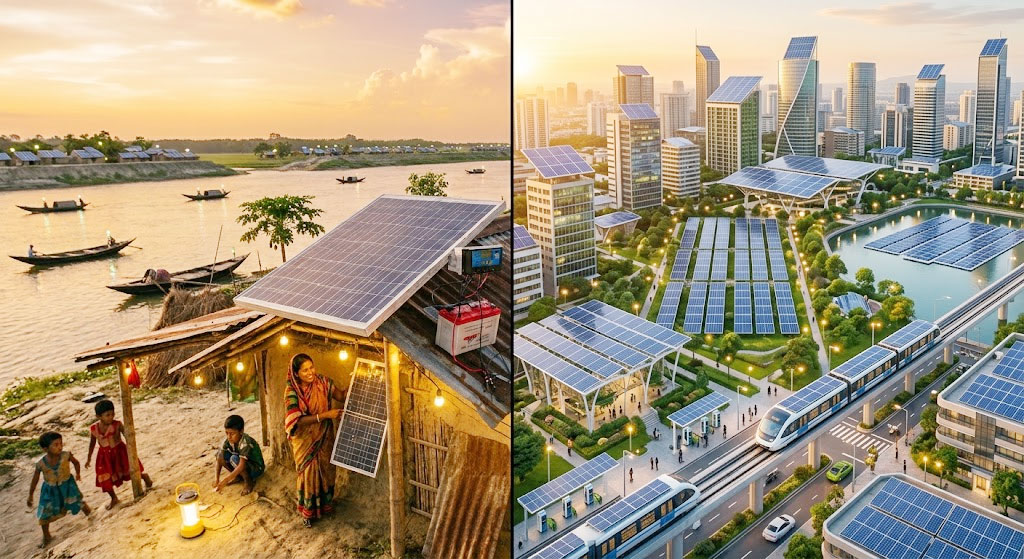
None of this is to say renewables have no place. Bangladesh's success in off-grid Solar Home Systems proves their value as a supplement. But to frame them as the primary solution for a grid that will soon demand 25,000 MW is to ignore the mathematics. While the brochures show us windmills and silicon, the government revived a 1,200 MW of coal at Matarbari, beside an already existing power plant.In a crisis, we reach for what works. True energy sovereignty will not be found in optimistic headlines, but in a policy that acknowledges the high cost of the sun going down.
Ismot Hasnine Masrur E Khuda is a researcher and public policy analyst. He can be reached at ismothasnine111@gmail.com.