
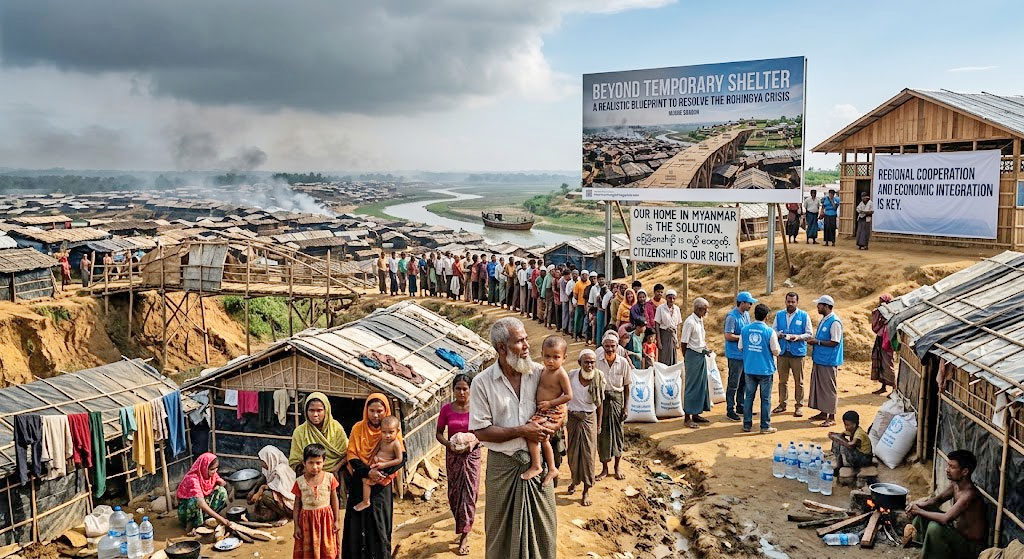
For years, the vast, sprawling bamboo settlements of Cox’s Bazar have stood as a monument to human tragedy and Bangladesh’s extraordinary generosity. When over 700,000 Rohingya fled horrific ethnic violence in Myanmar, Bangladesh opened its borders, offering safe harbor to a deeply persecuted people. But generosity without a long-term, viable resolution is not a strategy. Years later, the crisis has calcified into a protracted stalemate. The camps face escalating security challenges, aid budgets globally are shrinking under donor fatigue, and Bangladesh continues to bear an disproportionate burden.
To break this impasse, the international community and regional actors must move past incremental fixes and address the crisis at its structural root. Resolving the Rohingya crisis requires a cohesive, realistic framework based on regional diplomacy, economic integration, and verifiable guarantees of safety and citizenship in Myanmar.
The Myth of Immediate Repatriation vs. The Reality
For years, official discussions have centered almost exclusively on safe, voluntary, and dignified repatriation. While repatriation remains the ultimate legal and moral objective, insisting on immediate return without fundamental changes inside Myanmar’s Rakhine State is impractical. Civil conflict in Myanmar has intensified, and power dynamics on the ground have shifted dramatically. Expecting vulnerable families to return to an active war zone where the basic rights of citizenship remain denied is unrealistic.
Instead of treating repatriation as an all-or-nothing immediate condition, stakeholders must adopt a phased, conditions-based roadmap. Repatriation cannot occur in a vacuum; it requires verifiable benchmarks, international monitoring, and structural reforms within Myanmar regarding the legal status of the Rohingya.
Re-Engaging Regional Powers
A major blind spot in resolving the crisis has been the reliance on broad international declarations while regional powers remain largely passive or fragmented. The key to influencing Myanmar’s political trajectory lies within Asia.
Regional neighbors—particularly members of ASEAN, China, and India—have significant economic and geopolitical stakes in Rakhine State. Instability, transnational crime, and human trafficking along the Bay of Bengal serve no one's long-term interests. A coordinated regional diplomatic initiative must tie Myanmar’s broader economic and political engagement to concrete progress on Rakhine State.
Furthermore, engaging non-state actors who currently control significant territory in Rakhine State is becoming an unavoidable necessity. Diplomatic channels must adapt to the evolving realities on the ground to ensure any future return is safe and negotiated with local stakeholders who exercise practical control.
Shifting from Aid Dependence to Empowerment
Inside the camps in Bangladesh, a humanitarian approach based solely on basic aid distribution is no longer sustainable. With global humanitarian funding stretched across multiple world crises, aid cuts have directly impacted food rations, healthcare, and security in the camps.
A realistic transition is needed—moving from passive crisis management to active capacity building. Expanding access to formal education, vocational training, and skills development within the camps does not mean permanent integration; rather, it prepares the Rohingya community for self-reliance. Educated, skilled individuals are far better equipped to rebuild their lives and communities when they eventually return to Myanmar. Providing meaningful engagement also counters the growing threat of gang violence and illicit networks within the refugee settlements.
Establishing International Protection and Citizenship
No repatriation agreement will succeed unless the underlying cause of the exodus is addressed: the systemic denial of rights and citizenship under Myanmar’s 1982 Citizenship Law. The international community, through multilateral institutions and legal channels, must maintain consistent pressure to ensure that any eventual return includes a clear, legal path to citizenship, freedom of movement, and access to basic public services.
International oversight—potentially through a UN-monitored safe zone or civil observer presence in Rakhine—will be essential to build the necessary trust for refugees to voluntarily return.
The Path Forward
The Rohingya crisis is not merely a humanitarian dilemma for Bangladesh to manage indefinitely; it is a regional security and human rights challenge that demands serious, sustained global action. The current status quo—where a million displaced people remain trapped in limbo—is unsafe and unsustainable for Bangladesh, for regional stability, and above all, for the Rohingya people themselves.
By shifting from reactive emergency management to a clear strategy focused on diplomatic pressure, regional responsibility, educational empowerment, and guaranteed rights, the international community can finally move toward a lasting, equitable solution.
For an overview of the ongoing humanitarian challenges and official discussions around repatriation, watch this discussion on the Rohingya crisis solution. This video provides relevant context on the official stance regarding repatriation as the central resolution to the crisis.
Financial Mirror/AH