Gross Domestic Product is the loudmouth of economics. It measures the churn, the noise, and the sheer volume of transactions moving through a country’s borders, crowning economic giants based on industrial scale and sheer output. But GDP tells us next to nothing about what a regular human being actually owns. If you want to know which nations are genuinely wealthy, you have to ignore corporate ledgers and government balance sheets and look instead at median wealth per adult—a metric that measures what the citizen right in the middle of society actually possesses in property, savings, and pensions, minus their debts.
When you shift the lens from national economic output to what everyday people keep in their pockets, a radically different map of the world emerges. The traditional superpowers fade into the background, replaced by quiet nations where prosperity is deeply rooted, widely distributed, and fiercely protected.
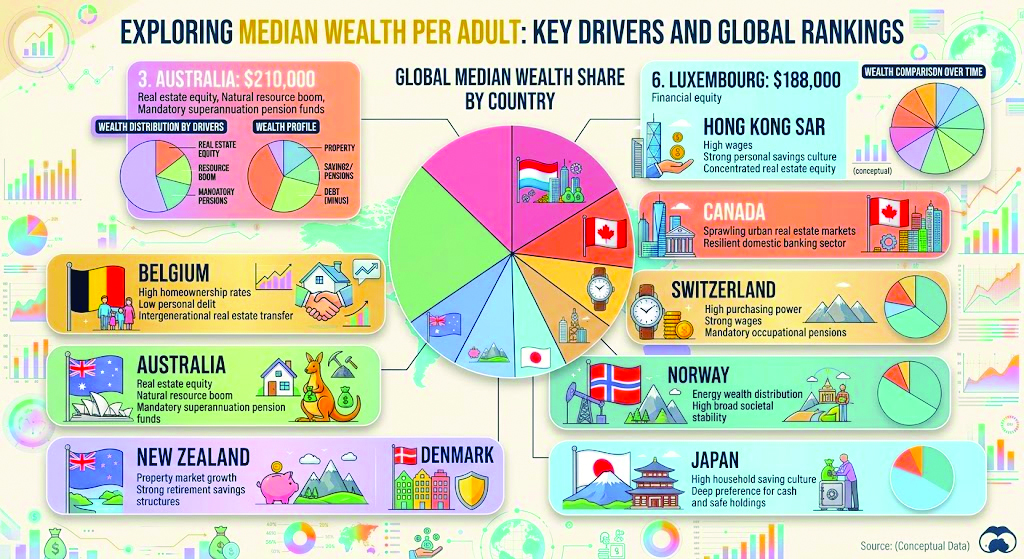
At the very pinnacle of this hidden global hierarchy sits Luxembourg, where the typical adult commands a staggering median net worth approaching $400,000.
This tiny European enclave achieves its position not through raw industrial muscle, but by serving as an elite financial engineering hub for cross-border capital, combined with exceptionally high salaries and robust institutional wealth-sharing that ensures ordinary residents share in the microstate’s massive financial surplus.
Right behind it, Belgium proves that you do not need to be a tax haven or a petrostate to build a wealthy populace. With a median wealth hovering around $277,000, the average Belgian is remarkably secure. This prosperity is built on a foundation of exceptionally high homeownership rates and a cultural aversion to reckless personal debt, where families historically pass down bricks and mortar rather than mortgages across generations.
The wealth narrative shifts sharply as it reaches the Southern Hemisphere, where Australia and New Zealand occupy the next rungs with median adult net worths exceeding $210,000 and $206,000 respectively. Down Under, prosperity has been supercharged by decades of relentless property booms, robust natural resource exports, and mandatory retirement savings systems—such as Australia’s superannuation—which force continuous capital accumulation into the hands of the workforce from their earliest employment years.
Moving into Northern Europe, Denmark demonstrates that high taxation and robust social safety nets are not mutually exclusive with personal affluence. Sitting comfortably with a median wealth of over $203,000, the average Dane benefits from sophisticated cooperative housing structures, comprehensive pension investments, and a stable economy that cushions citizens against economic shocks while allowing personal assets to compound over a lifetime.
In Asia, Hong Kong SAR carves out a unique space with a median net worth touching $188,000. Despite severe income inequality and some of the most expensive urban real estate on earth, the city’s role as an indispensable global financial gateway ensures that high local wages, aggressive personal savings habits, and concentrated property equity elevate the financial baseline of its citizens.
Canada and Switzerland present a fascinating study in contrasts. Canada’s sprawling real estate markets and resilient banking sector secure a median adult wealth of roughly $148,000. Switzerland, meanwhile, is famous for topping average wealth tables thanks to an ultra-wealthy elite and massive private banking accounts, but when measured by the median citizen, its everyday residents sit at around $145,000—cushioned by strong franc purchasing power, high wages, and mandatory occupational pension funds.
Rounding out the top tier are Norway and Japan, nations that achieve high median wealth through distinct cultural and structural disciplines. Norway successfully channels its North Sea energy bounty not just into state coffers, but into broad societal stability, resulting in a median wealth of $140,000. Japan, despite navigating decades of sluggish macroeconomic growth and staggering national government debt, maintains a remarkable median net worth of approximately $135,700. This resilience stems from a legendary cultural commitment to household saving and a deep domestic preference for cash and safe deposit holdings.
Ultimately, these nations remind us that true national wealth is not merely about how much a country produces in a factory or transacts on a trading floor. It is measured by the safety net woven beneath its people, the equity they hold in their homes, and what remains in their hands when the ledger finally closes.