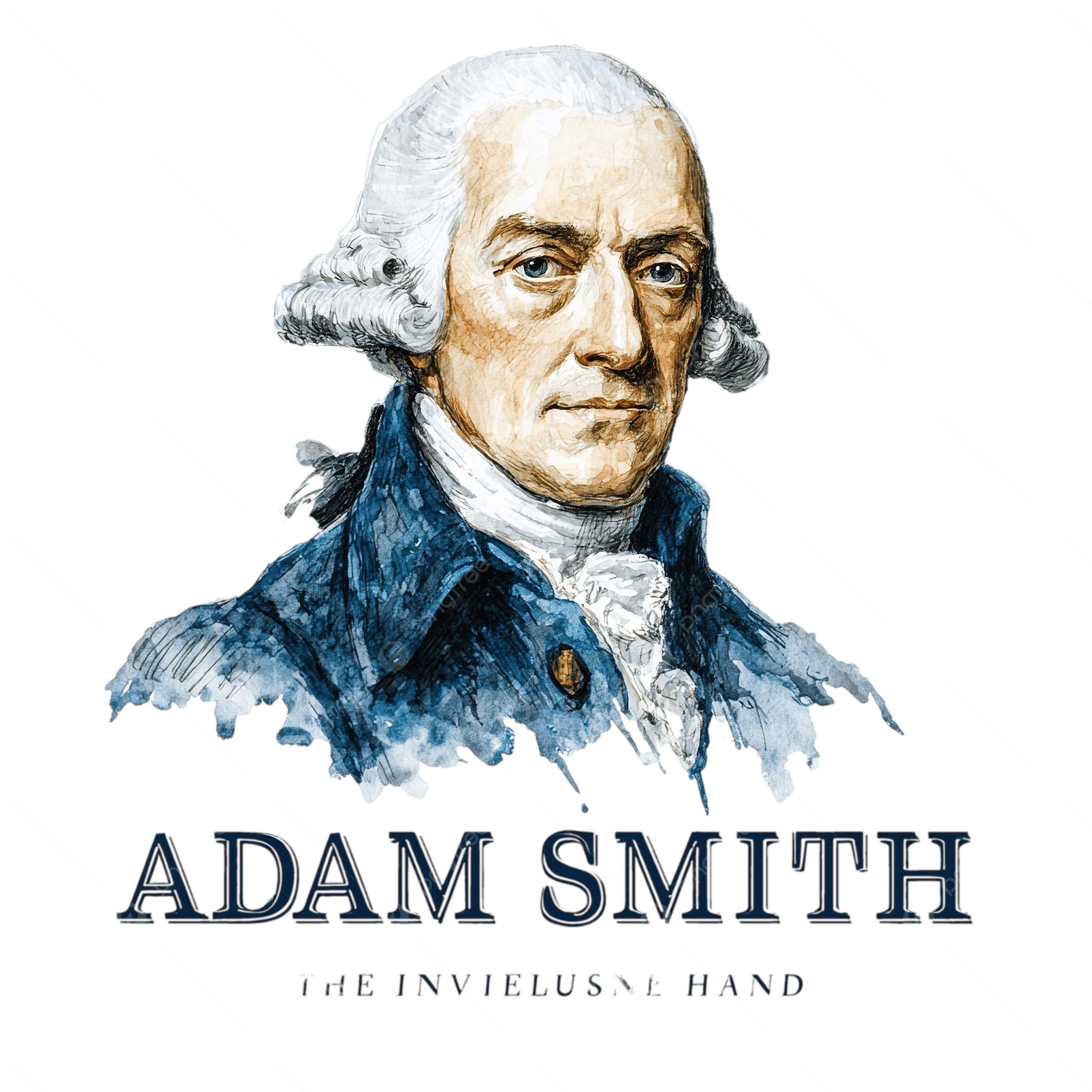
INTERVIEWER: Dr. Smith, welcome across two and a half centuries. When you published The Wealth of Nations in 1776, the world was driven by waterwheels, horse-drawn carts, and mercantilist empires. Today, wealth is generated by microchips, artificial intelligence, and global digital networks. What goes through your mind looking at our world?
ADAM SMITH:(Smiles thoughtfully, adjusting his spectacles) First, immense wonder at the sheer abundance. In my day, the primary struggle of mankind was basic subsistence—procuring enough bread and wool to survive the winter. To see ordinary citizens holding devices that connect them instantly to all human knowledge is extraordinary.
Yet, underneath these remarkable digital machines, I see that the fundamental principles of human nature have not changed a single whit. The laws of trade, human motivation, and the division of labor remain precisely as they were when I walked the streets of Glasgow.
On "The Invisible Hand" & The Modern Market
INTERVIEWER: You are famous for coining the concept of the "Invisible Hand"—the idea that individuals pursuing their own self-interest inadvertently promote the good of society. Today, massive corporations command trillions of dollars. Does the Invisible Hand still work when power is so concentrated?
ADAM SMITH: People often misunderstand what I wrote about self-interest. I never said greed was a virtue; I said that self-interest, when bound by justice and open competition, directs human energy toward public benefit.
When a business grows wealthy by offering a better product at a lower price, that is the Invisible Hand at work. But when a handful of giant monopolies conspire to block new competitors, buy out rivals, or influence legislators to protect their market position, that is not free-market capitalism—that is a modern version of the mercantilist monopolies I spent my life fighting against!
On Artificial Intelligence and the Division of Labor
INTERVIEWER: In Chapter One of your work, you famously used a pin factory to explain how dividing labor into specialized tasks increases productivity exponentially. Now, Artificial Intelligence is automating complex mental tasks—writing code, analyzing legal cases, and processing financial trades. Does automation worry you?
ADAM SMITH: Not in the long run, though the transition requires great care. When a pin maker no longer needs to forge wire by hand because a machine does it faster, pin prices drop, and human energy is freed to create new goods and services that did not exist before.
However, I issued a warning in The Wealth of Nations that remains vital today: if a worker’s entire life is spent performing a single repetitive, mechanical task, their mind becomes dull and dormant. If AI takes over routine mechanical and cognitive tasks, it should elevate human labor toward creativity, philosophical inquiry, and genuine human connection. The goal of economic progress is not merely to produce more material goods—it is to cultivate fully developed human beings.
On Wealth Inequality & Moral Sentiments
INTERVIEWER: Many critics argue that modern global markets create staggering wealth for top executives while ordinary workers struggle with rising living costs. How would the author of The Theory of Moral Sentiments respond to modern inequality?
ADAM SMITH:(Leans forward, voice sharpening) A society cannot be flourishing and happy if the far greater part of its members are poor and miserable. No society can survive if it is devoid of empathy—what I called "fellow-feeling."
ADAM SMITH'S CORE ETHICAL PRINCIPLE
┌─────────────────────────────────────────────────────────────────┐
│ "No society can surely be flourishing and happy, of which the │
│ far greater part of the members are poor and miserable." │
│ — The Wealth of Nations│
└─────────────────────────────────────────────────────────────────┘
Real wealth is not measured by the gold in a central bank's vaults or the stock valuations of a few mega-corporations. Real wealth is measured by the real living standards of the working majority—their ability to afford nutritious food, decent housing, quality education, and leisure. If a system produces immense luxury at the top while leaving the working class in perpetual insecurity, the market mechanism is being distorted.
Final Advice for the Future
INTERVIEWER: Dr. Smith, if you were advising world leaders and young professionals today on how to build a prosperous future, what would be your final message?
ADAM SMITH: Remember that market freedom and moral responsibility are two sides of the same coin. Freedom without justice becomes lawlessness; competition without empathy becomes cruelty.
Set your markets free from corrupt monopolies, allow human ingenuity to flourish across borders, educate every child regardless of background, and never forget that the ultimate purpose of economic growth is to serve human dignity and happiness.
INTERVIEWER: Dr. Smith, thank you for bridging two centuries of economic wisdom.